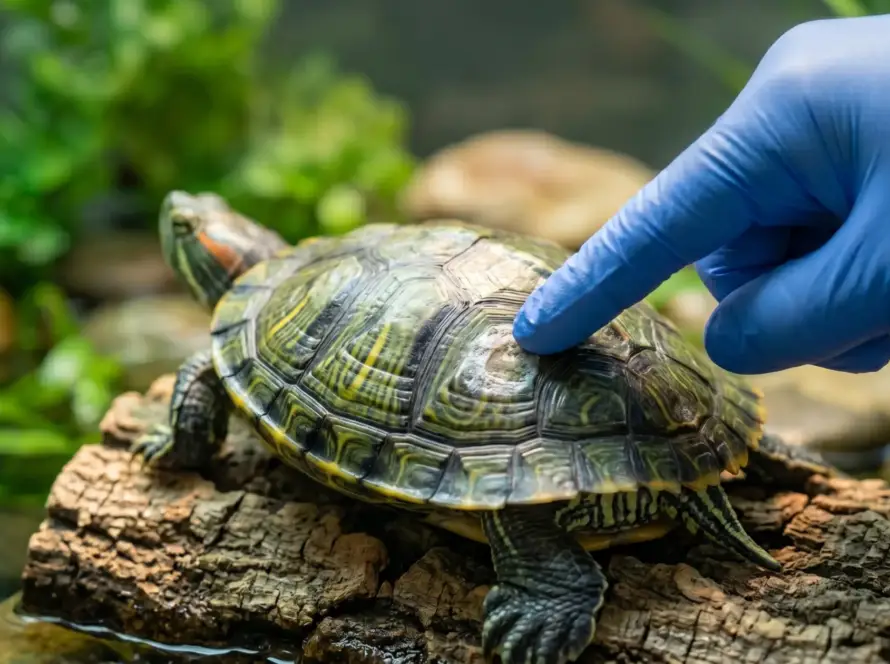

Walk into almost any pet shop, and you will see it: aquatic turtles with shells that look like stacked staircases.
Many first-time keepers assume this spiked, textured look is either a genetic trait or a unique growth pattern. It is neither. Shell pyramiding is a permanent, crippling skeletal deformity. It is a man-made pathology triggered by a cascade of mechanical and nutritional failures in the animal’s environment.
Here is the exact biological breakdown of why shell pyramiding occurs in captive turtles, and how to engineer your setup to prevent it from starting.
Q: What exactly is shell pyramiding, biologically speaking?
It is a severe metabolic bone disorder. The turtle’s carapace (the top shell) is composed of underlying living bone covered by scutes made of keratin. Pyramiding occurs when the bone grows at a highly accelerated vertical rate, forcing the keratin scutes to stack vertically into distinct, raised peaks rather than expanding horizontally into a smooth, flattened dome.
Q: Most care sheets blame diet. How does food trigger this deformity?
In the wild, an aquatic turtle’s growth is slow, heavily regulated by seasonal fasting and a lean diet. In captivity, keepers frequently power-feed them commercial pellets loaded with cheap, easily digestible proteins.
When a turtle consumes excessive protein, it forces the osteoblasts (the cells responsible for bone formation) into overdrive. The underlying bone expands rapidly. However, the outer layer of the shell cannot shed its keratin fast enough to keep up with this explosive skeletal growth. Because the scutes are essentially “tight” across the top of the shell, the rapidly expanding bone has nowhere to go but up.
Q: Can pyramiding happen even if the diet is perfectly balanced?
Absolutely. If your lighting system is flawed, the shell will deform. Bone density depends on a strict calcium-to-phosphorus ratio, but calcium cannot be absorbed by the turtle’s gastrointestinal tract without Vitamin D3. For a turtle to synthesize D3, it requires direct exposure to high-output UVB radiation.
This is where Jugaad setups actively fail the keeper. If your turtle is starving for UVB, the calcium in their diet passes right through them. The body responds by pulling calcium from the existing skeleton to maintain blood calcium levels. Pyramiding is one of the most visible, early-stage symptoms of this Metabolic Bone Disease (MBD).
Q: Does the humidity in the room play a role in shell growth?
Yes, the microclimate directly above the basking dock is critical, particularly during the dry Indian winters.
When a turtle hauls out to bask under an intensely hot, dry bulb in a low-humidity room, the keratin scutes dry out rapidly. This extreme lack of moisture causes the keratin to physically contract and tighten. If the turtle is simultaneously experiencing rapid bone growth from a high-protein diet, this tight, dry keratin acts like a corset, forcing the soft, growing bone to stack vertically into those distinct pyramids.
Q: Is it possible to reverse a pyramided shell?
No. Once the bone grows vertically, the structural damage is permanent. You cannot reverse a pyramided shell; you can only halt its progression by radically overhauling your husbandry and environment.
Q: How do I engineer my setup to ensure my turtle’s shell grows perfectly smooth?
A smooth, perfectly domed shell is the ultimate proof of ethical herpetoculture. It requires abandoning the “Fish tank or Plastic Tray” mentality and treating your turtle’s habitat as a permanent, clinical life-support system.
We refuse to accept the people’s standard of using unethical, poor ventilation, and cheap materials habitats, because they directly cause these pathologies. At Terranova, our setups are built around uncompromising architectural and biological standards.
Our premium reptile enclosures are engineered specifically to combat the challenges of the Indian climate. We use custom, marine-grade, rust-proof ventilation systems that completely eliminate the restrictive barrier found in cheap tanks. This guarantees maximum full-spectrum UVB transmission directly to the basking zone, ensuring your turtle receives the exact radiation required for flawless, smooth shell calcification.
Furthermore, our dedicated logistics framework ensures that when you invest in a permanent, high-clarity glass habitat, it is consolidated and freight-forwarded with absolute precision, arriving at your door in pristine condition.
If you are battling failing setups, it is time to upgrade. Explore our premium habitats & accessories to build an ecosystem that respects the biology of the pet you keep.