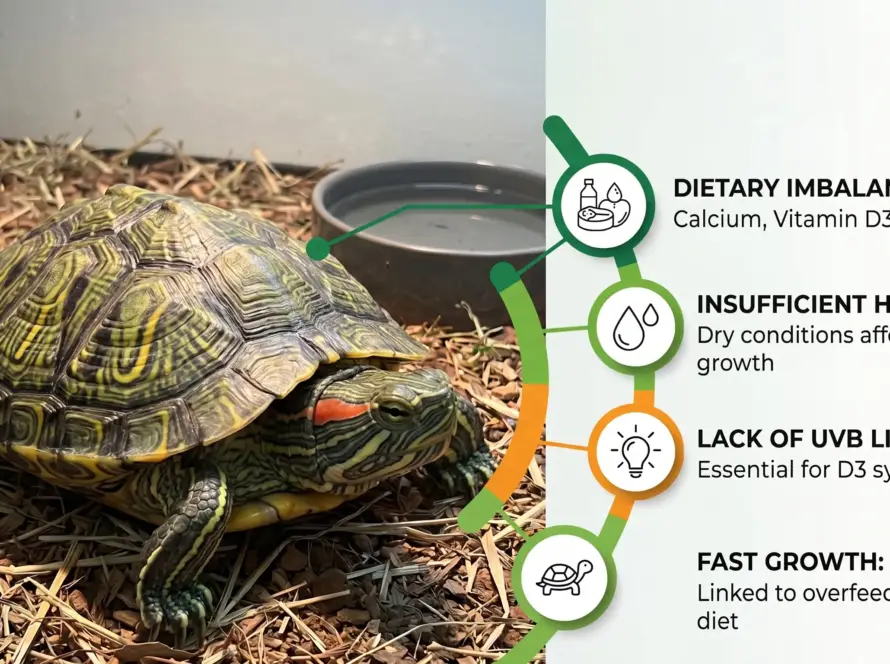

You notice a small, chalky white spot on the carapace. Or perhaps one of the scutes feels just slightly pliable under your thumb when you pick them up for a health check.
For aquatic turtle keepers, especially those of us battling the heavy, suffocating humidity of the Indian monsoon season, this is a gut-sinking moment. Ulcerative Shell Disease, commonly known as shell rot, is the silent killer of semi-aquatic reptiles. It does not happen overnight, but once a bacterial or fungal infection takes hold, it rapidly degrades the keratin and underlying bone of your animal.
The hard truth? Shell rot is almost never a random act of nature. It is a direct symptom of mechanical failure in your husbandry.
Here is exactly how to identify early-stage shell rot, why your current setup is likely causing it, and the clinical steps to stop the infection dead in its tracks.
1. The Diagnostic Checklist: Is It Actually Shell Rot?
In the early stages, shell rot mimics harmless hard water stains or a difficult shed. You need to know exactly what you are looking at before the infection reaches the bloodstream.
- The Visual Test (Pitting): Healthy keratin is smooth and firm. Early shell rot often presents as tiny, white, or gray indentations. These aren’t just surface stains; if you look closely, they are literal “pits” eating into the shell. You might also notice a reddish, bruised hue beneath the scutes (particularly on the plastron/belly), indicating blood pooling as the infection reaches the bone.
- The Tactile Test (Soft Spots): A healthy aquatic turtle’s shell should feel exactly like a thick human fingernail. Press gently on the discolored spot. If it feels spongy, yields to pressure, or secretes fluid, the keratin’s structural integrity is gone. The infection is active.
- The Olfactory Test (The Smell): This is the most undeniable symptom. A healthy tank smells like clean, cycling aquarium water. Shell rot smells like a stagnant, rotting swamp. If you detect a foul, putrid odor coming directly from the shell, necrotizing tissue is already present.
- Behavioral Shifts: Turtles hide pain exceptionally well. However, if your turtle suddenly refuses to enter the water and spends 24 hours a day under the basking lamp, it is instinctively trying to dry out a severe fungal or bacterial bloom.
2. The Setup Failure: Why Did This Happen?
You cannot treat the shell without fixing the environment. In the Indian climate, three compounding factors usually trigger these infections:
- Sinking Mass-Market Basking Docks: Aquatic turtles must be able to get 100% dry. If you are using a cheap plastic suction dock, your adult turtle’s weight is likely causing it to sink just enough to keep their plastron wet. If their belly is constantly sitting in a millimeter of water, it will rot. They require something like TerraNova floating basking dock (https://terranovastore.in/product/terranova-dock-floating-basking-platform/ ) which will automatically float and adjust as per water levels.
- Toxic Water Quality: Turtles produce a massive biological load. If your filtration is struggling, ammonia and nitrate spikes cause microscopic chemical burns on the shell, opening the door for pathogenic bacteria.
- Stagnant Air and Blocked Light: This is the fatal flaw of poor enclosures. They block up to 40% of the crucial UVB light required for shell calcification, while simultaneously trapping stagnant, humid air inside the tank. Without high-end cross-ventilation, bacteria thrive.
3. The Terranova Standard: Premium Engineering for Prevention
You cannot compromise on life support systems. We refuse to accept the tubs, buckets or aquariums as their homes because they actively harm the animals we care for.
At Terranova, our Enclosures are rooted in high-end quality & uncompromising ethical care. Our enclosures are engineered specifically to be compatible for the Indian climate. We utilize high quality ventilation systems that create maximum cross-airflow, completely eliminating stagnant pockets where shell rot breeds.
By removing the restrictive barrier, our habitats allow maximum full-spectrum UVB penetration, ensuring your turtle’s shell hardens the way nature intended. If you are constantly battling water parameters and humidity spikes, explore our premium enclosures at https://terranovastore.in/product-category/enclosures/ to permanently upgrade your setup.
4. Immediate Clinical Action (First-Aid Protocol)
If you have identified the symptoms above, you must act today to stabilize your shelled friend.
- Strict Dry Docking: Remove the turtle from the water immediately. Place them in a dry, sterile, plastic hospital tub (you can use TerraNova Pod – Stackable den – https://terranovastore.in/product/terranova-pod-stackable-den/) with proper overhead heating (ensure a gradient to prevent overheating) and a dedicated UVB source. They should only be placed back in clean water for about 45–60 minutes a day to drink, eat, and defecate.
- Sterilize the Shell: Gently clean the infected area with a soft-bristled toothbrush and a diluted povidone-iodine (Betadine) solution. Allow the iodine to air dry completely on the shell before placing them back in the hospital tub. Never attempt to peel, pick, or scrape the rotting scutes yourself.
- Book an Exotic Vet: Early-stage rot can sometimes be treated topically, but if the infection has reached the bone or entered the bloodstream (septicemia), your turtle will require a course of systemic, injectable antibiotics. Do not guess with their life.
- Tear Down the Tank: While the turtle is dry-docked, you must work on the enclosure. Sterilize the glass, upgrade your filtration media, and discard any porous decor that might harbor bacteria.
Your turtle’s shell is their absolute lifeline. By abandoning cheap and unethical setups and investing in uncompromising, engineered TerraNova habitats, you ensure they thrive for decades, rather than just surviving the season.